Top 10 NEBOSH IGC Exam
TIPS!
Nebosh IGC Exam Tips | Nebosh IGC Exam | Nebosh IGC Exam Preparation | Nebosh IGC Scenario Based Exam | Nebosh Open Book Examination
Top 10 NEBOSH IGC Exam Tips to Pass First Time
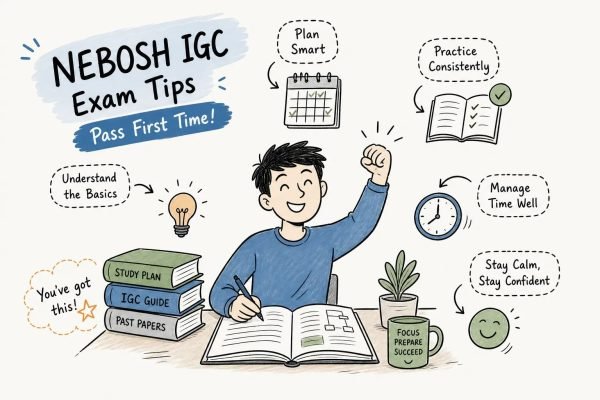
These NEBOSH IGC exam tips show you exactly how to pass on your first attempt, not by working harder on the wrong things, but by combining smart preparation with proven exam technique. Candidates who fail rarely struggle because the content is too hard. They struggle because they walk into the assessment without a clear strategy. Hard work and smart preparation are two very different things.
This article gives you ten specific, actionable NEBOSH IGC tips covering exam format awareness, command word mastery, time management for the 24-hour open-book exam, scenario-based answer structure, and revision planning. Candidates who complete accredited NEBOSH IGC courses run by experienced providers in the UAE often enter the assessment with these exact frameworks already practiced under realistic conditions, giving them a clear edge over self-studiers who discover these techniques far too late.
Before you study a single topic, understand exactly what you are being assessed on. Many candidates still revise for a traditional written exam when the format has moved on significantly. Knowing both components upfront shapes every preparation decision you make.
Tip 1: Know what GIC1 actually tests
GIC1 is a 24-hour open-book, scenario-based online exam followed by a short verification interview. The provisional pass mark is 45 out of 100, with grades running from Pass (45 to 64) through Credit (65 to 74) to Distinction (75 and above). "Open-book" does not mean easy. The exam rewards application and analysis, and the scenario is deliberately unfamiliar, so copy-pasting notes will not work. You have approximately 3,000 words to distribute across roughly 10 tasks, which works out to around 33 words per mark available.
Tip 2: Know what GIC2 demands from you
GIC2 is a practical workplace risk assessment submitted online. In 2026, GIC2 uses points-based marking out of 100, with a 60% pass threshold, meaning you need at least 60 marks to pass. This shift from the older pass/fail approach is significant. Vague hazard identification without thorough documentation will cost you marks across every section. Treat GIC2 as a structured project that needs to be complete, detailed, and well-evidenced from start to finish.
NEBOSH publishes official definitions for its command words and uses them deliberately to signal how much depth each answer requires. Ignoring command words is the fastest way to lose marks on content you already know, and it is the one exam skill that takes the least time to fix.
Tip 3: Match your answer depth to the command word
There are four command words you will encounter most often. "Identify" asks for a name or short phrase only. "Outline" asks for key features briefly, without exhaustive detail. "Describe" asks for a detailed factual account of features, but not an explanation of why. "Explain" asks you to show the why or how behind something.
The difference matters in practice. If a question asks you to "explain why edge protection prevents falls," an answer that says "edge protection acts as a barrier" earns nothing. A scoring answer adds: "by physically preventing a worker from reaching the unprotected edge, reducing the likelihood of a fall from height."Tip 4: Use the one-mark-per-point rule to size your answers
One valid, developed point earns one mark. An 8-mark question needs eight distinct, developed points. Bullet points without explanation rarely score well because each point needs a short, complete thought behind it. When you see the mark allocation at the top of a question, treat it as a checklist: if you have written six points for an 8-mark question, you are two marks short before you have even checked your content.
Twenty-four hours sounds generous until you realize that without a plan, most candidates spend the first two hours rereading notes and the last two hours rushing through final questions. Strong time management separates confident passes from stressed re-sits. The format rewards candidates who treat the exam like a managed project, not a marathon writing session.
Tip 5: Plan your approach before drafting a single answer
Spend the first 30 to 60 minutes reading the scenario carefully. Annotate the key hazards, job roles, workplace type, and any specific details the examiner has planted. Map each question to the relevant unit topic before drafting a single answer. Treating GIC1 like a structured project rather than an improvised writing session produces focused, scenario-anchored answers that score consistently across all tasks.
Tip 6: Set personal deadlines per question and stick to them
Allocate roughly 20 to 25 minutes per task on average, then adjust for mark weighting. A 10-mark question deserves more time than a 4-mark question. The critical rule: a slightly underdeveloped answer on every question outscores one brilliant answer and three incomplete ones. Leaving a question blank is a guaranteed zero; a partial answer always has a chance of picking up marks.
The GIC1 scenario is the exam. Every answer must connect back to the specific workplace situation described, not general HSE theory. Examiner feedback consistently identifies “generic, textbook-style answers” as the most common reason candidates lose marks on questions they clearly know the content for, which means knowing the material is necessary but never sufficient on its own.
Tip 7: Anchor every answer in the scenario details
Read the scenario for the specific industry, the job being performed, the hazards already described, and the people involved. Then use that detail directly in your answers. If the scenario involves a construction site with unguarded excavations, a control measure answer should reference that specific situation: "install edge protection along the excavation perimeter to prevent workers from approaching the unprotected edge" performs far better than "use guardrails to prevent falls." The scenario is there to help you; use it
Tip 8: Use a simple three-part answer structure
For any question requiring more than a list, use this structure: state the point, explain why it matters in this specific context, then link it back to the scenario. This mirrors how NEBOSH markers award credit and stops you from writing lists when the command word is asking for explanation. It also forces you to develop each point fully rather than piling up shallow bullet points that collectively earn half the marks available.
Revision quality matters more than revision volume. Using too many materials at once, or relying on the wrong ones, wastes preparation time that should go toward understanding and application. NEBOSH guidance and accredited provider course plans typically recommend a 10 to 12 week part-time revision timeline for IGC candidates, with the final two to three weeks reserved for timed practice and weak-area review.
Tip 9: Use official materials as your revision core
Start with the NEBOSH official course book and the current 2026 syllabus guide. Supplement with one structured revision guide from POSHE LMS, specifically editions updated for the 2026 syllabus. Avoid building your revision around unofficial "solved paper" compilations as a primary source; use them for additional practice only after working through the official materials first.
Tip 10: Get expert-led guidance on exam technique early
Candidates who train with an accredited provider get more than content delivery. Experienced NEBOSH trainers work through command word application and live scenario practice, with marking scheme logic woven through both. At Poshe Solutions, a NEBOSH-accredited training provider based in Dubai, IGC trainers embed these exact exam techniques into every preparation session, so candidates practice answering the right way long before the exam window opens. Courses start from AED 1,300, with online live and eLearning formats designed to fit around full-time work schedules across the UAE.
NEBOSH examiner reports are one of the most underused preparation tools available to candidates. They tell you exactly what loses marks, from the perspective of the person awarding them. Reading even one examiner report before your exam is worth more than an extra evening of note revision.
Passing the NEBOSH IGC first time comes down to knowing the format cold and executing the right exam technique, backed by a revision habit that reflects how the marking scheme actually works. None of this requires guesswork when you have the right framework in place before the assessment window opens.
The ten NEBOSH IGC exam tips in this article only deliver results when practiced under realistic conditions before exam day. Start with the command words, map your revision to the official 2026 syllabus, and work through scenario-based practice answers regularly. Generic notes will not get you there; applied understanding will.
Before you submit your GIC1 answers, run through this check to avoid the most common pitfalls:
Use these NEBOSH IGC exam tips to focus your final weeks of revision. If you want structured feedback on your scenario answers and exam technique built into the training from day one, Poshe Solutions offers accredited NEBOSH IGC preparation in Dubai and across the UAE, starting from AED 1,300. Online live classes and flexible eLearning formats mean you can prepare thoroughly without taking time off work. Contact Poshe Solutions to check the next available IGC intake and begin preparing with the right framework in place.
